
Know whether access was appropriate:
not just that it happened.
Thousands of clinicians, staff, and contractors can legitimately open a patient record. Intruno provides behavioral context around every one of those actions, so your team can tell the difference between routine access and something worth a closer look.
Request a DemoAccess, in the systems where it actually happens.
Views, edits, prints, and exports of electronic medical records
The relationship, if any, between the accessing user and the patient
Timing relative to scheduled shifts, department, and role
Patterns of access over time, compared to peers in similar roles
The same event, read two ways.
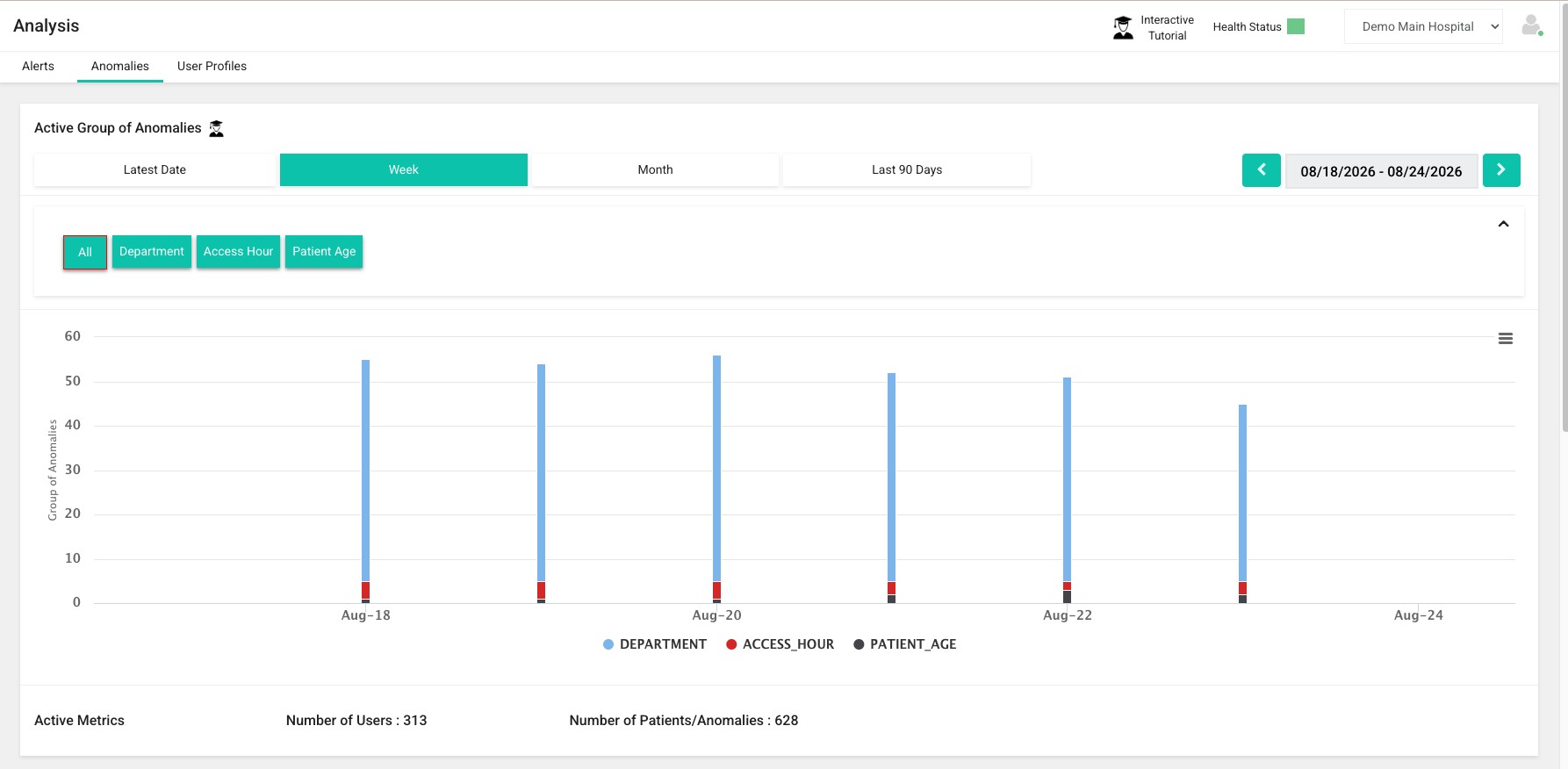
Behavior compared with peers
Anomalies compare each user’s activity with peers in the same job title and department over a rolling 90-day window, across three dimensions: department, access hour, and patient age.
Alerts grouped by relevance, not raw volume.
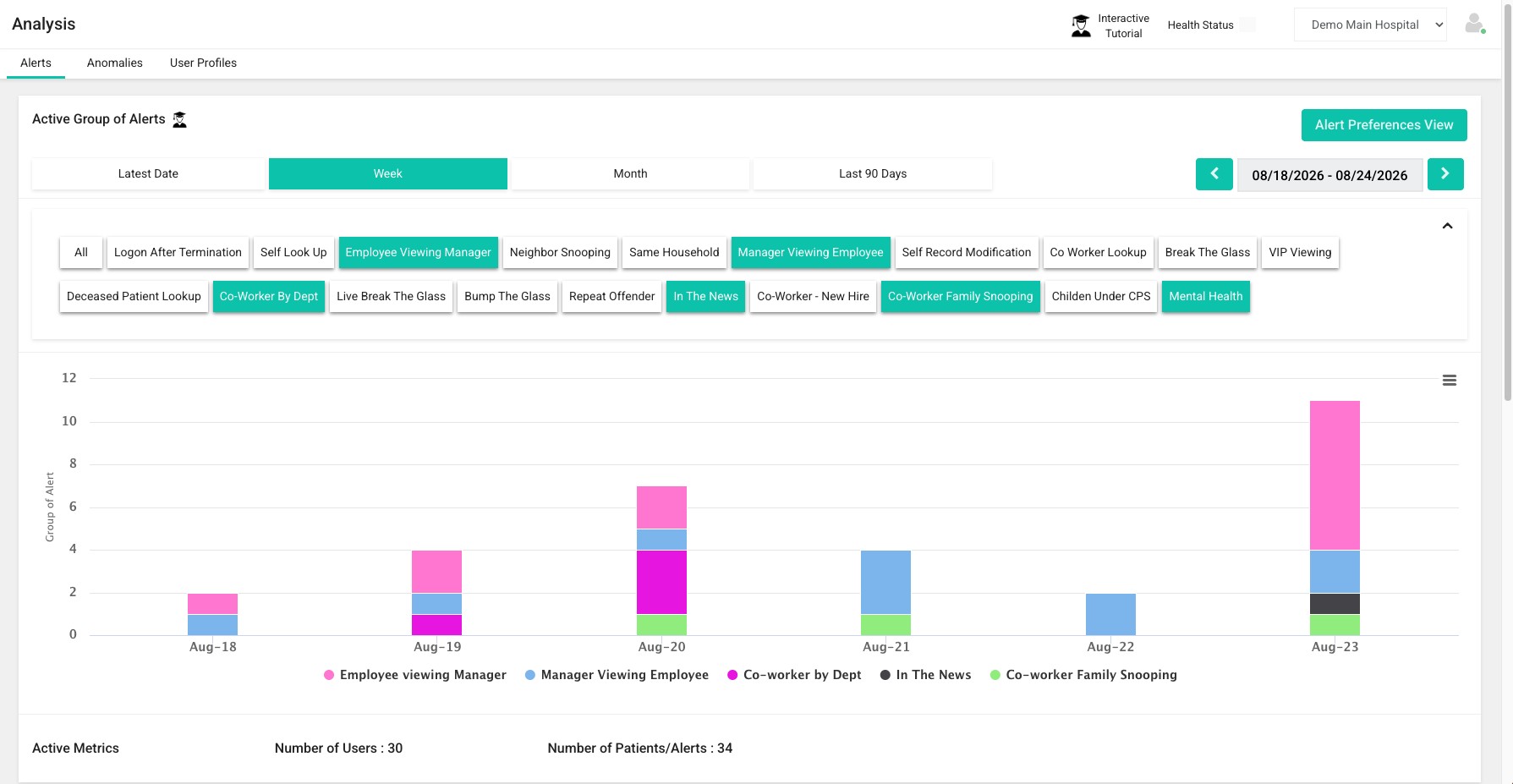
Findings by alert type, over time
Each configured alert type is a one-click filter. Selected types stack into a daily trend chart over a week, a month, or the last 90 days, so spikes are easy to spot.
From a flagged alert to a documented decision.
Investigation
Every flagged event opens with the evidence already assembled: access history, context, and prior related cases.
Privacy operations
Privacy teams work from a shared queue and case history instead of individually tracked spreadsheets.
Compliance support
Outcomes and evidence are documented as they occur, ready to support audit and regulatory requests.
What changes for your privacy team.
Fewer alerts that require guesswork about whether an access was appropriate.
A consistent, documented process for every access review, regardless of who’s reviewing.
Evidence that’s ready when compliance, legal, or a regulator asks for it.
Your EHR already logs every access. That’s not the same as monitoring it.
Every EHR generates audit logs. The problem is what those logs can and cannot tell you, and what it takes to turn raw event data into an actionable privacy finding.
Between an access event and a privacy finding, six things happen automatically
Here’s what Intruno evaluates before deciding whether an access warrants a privacy finding, and why each step matters for reducing false positives while surfacing the access that needs review.
Access event ingested
When a user opens a patient record in your EHR, the access event is captured in real time: user identity, patient record, system accessed, timestamp, and event type (view, print, export).
Context is collected
Before evaluating the access, Intruno assembles contextual information about the user: role, department, schedule, current assignments, and employment status, drawn from identity and HR systems connected during implementation.
Behavioral analysis runs
Intruno compares this access against the behavioral baseline built for this specific user, not a department average. Unusual volume, timing, location, or patient population stand out because they deviate from what this person normally does.
Care relationship is validated
This is the step that separates healthcare privacy monitoring from generic anomaly detection. Intruno checks whether a documented clinical relationship exists between this user and this patient. If a legitimate reason exists, the access is excluded before any finding is generated.
Policies are evaluated
Access events that fail care relationship validation are evaluated against Intruno’s library of pre-built healthcare privacy policies. Each policy specifies the conditions, risk level, and recommended response. Your team doesn’t need to write detection rules from scratch.
A privacy finding is delivered to your analyst
What reaches the privacy analyst is not a raw log entry. It’s a structured finding: the user, the patient, access details, care relationship check result, the policy triggered, behavioral context, and a recommended action. The analyst has everything needed to make a decision without opening a separate system.
Generic security monitoring tools weren’t built to understand clinical context
Enterprise monitoring platforms are designed for IT security teams. Healthcare privacy monitoring requires a fundamentally different understanding of how clinical access is supposed to work.
A generic security tool can tell you that a nurse accessed 47 patient records on a Tuesday afternoon. Intruno can tell you that 43 were her assigned patients, three were colleagues she’d previously treated, and one was her neighbor, and that the last access is the one that needs investigation.
What your team gains, organized by the problem each capability solves
Each capability exists because of a specific operational gap in how healthcare privacy monitoring works without it.
Continuous monitoring
Intruno monitors access events across your EHR environment at all times, not through periodic audits or scheduled log reviews. Violations don’t wait for quarterly reviews.
Privacy teams detect inappropriate access when it occurs, not weeks later.Individual behavioral baselines
Builds a behavioral model for each user based on their actual access history, not a role-level average. A deviation for a ward nurse means something different than the same deviation for a director.
Alerts reflect meaningful departures from individual behavior.Care relationship validation
Before any finding is generated, Intruno checks whether a documented clinical reason exists. Care team assignments, referrals, active consultations, and treating history are evaluated automatically.
What reaches the privacy team are real findings, not accesses that take 30 minutes to determine were clinically appropriate.Pre-built healthcare privacy policies
A library of pre-built policies covering the violation patterns healthcare privacy programs encounter most frequently. Your team doesn’t need to write detection logic from scratch.
Detection begins on day one, covering the scenarios that generate real HIPAA exposure.Explainable alerts
Every finding includes the full rationale: the behavioral baseline, the deviation, the care relationship check result, the policy triggered, and the access history. No unexplained scores or black-box risk ratings.
Analysts make better, faster decisions when they arrive at a finding with context already assembled.Risk prioritization
Not every finding requires the same urgency. Intruno organizes findings by risk level, helping privacy teams focus their attention on the cases most likely to represent genuine HIPAA exposure.
Privacy analysts spend their time on the cases that matter most.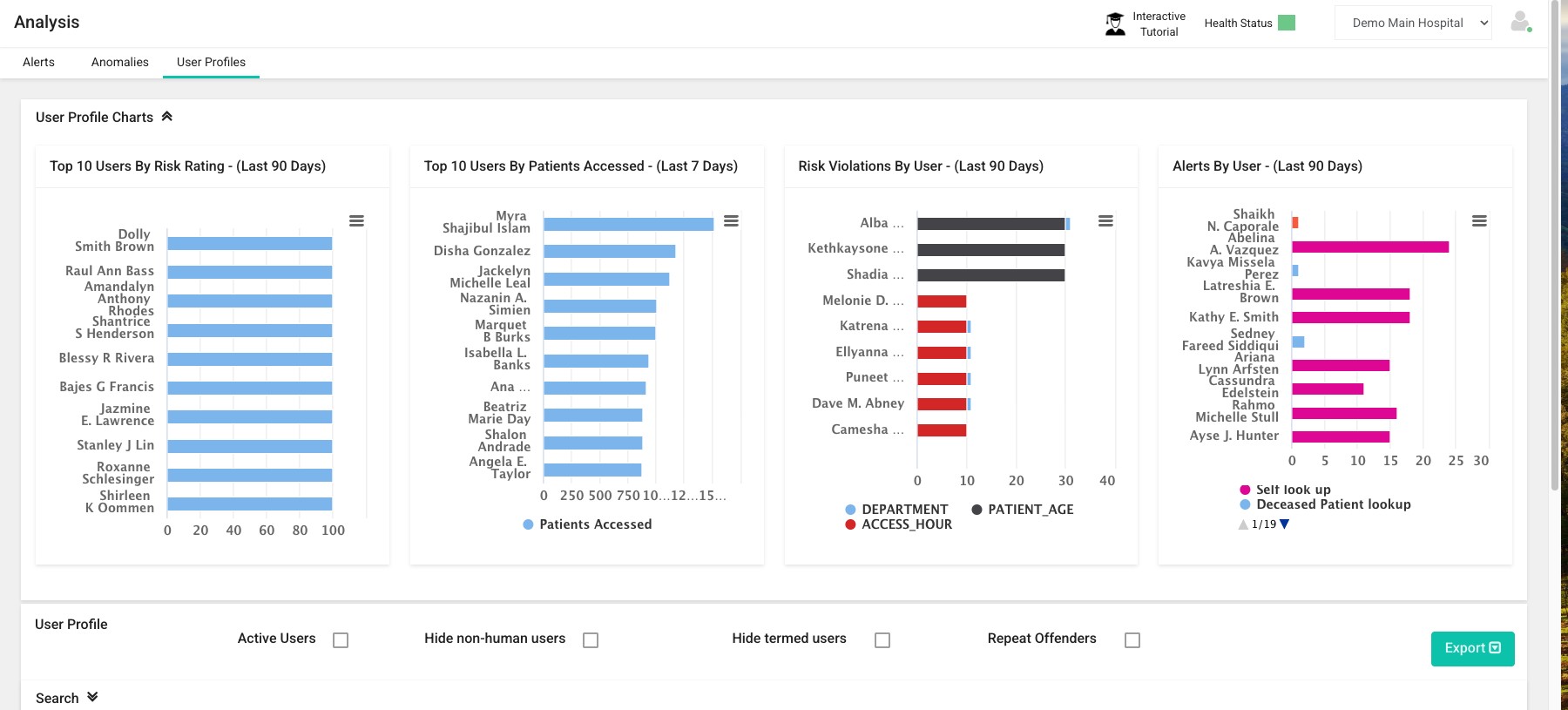
Risk rolled up by user
User profiles surface the highest-attention users by risk rating and patients accessed, and break down what drives each user’s risk: department, access hour, or patient age.
The access patterns that reach your privacy team
Each one is difficult to detect using audit logs alone because appropriateness requires context the log itself doesn’t contain.
High PriorityVIP patient access
VIP patient access
Patients flagged as VIP (elected officials, executives, public figures) face elevated risk of inappropriate access due to curiosity or recognition. Standard audit logs show the access. They don’t show whether the accessing employee had any clinical reason to be there.
What Intruno does: Validates care team membership and applies VIP-specific policies before generating a finding. Access outside the designated care team triggers an immediate privacy review.
CommonNeighbor and family member access
Neighbor and family member access
The most common privacy violation in healthcare. It frequently happens out of concern or curiosity rather than malicious intent, but the HIPAA exposure is the same regardless of motivation.
What Intruno does: Behavioral baselines surface access to records outside the employee’s normal patient population. Care relationship validation confirms no clinical reason exists. A finding is generated without manual log review.
Sensitive RecordBehavioral health record access
Behavioral health record access
Behavioral health records, including substance use disorder records subject to 42 CFR Part 2, carry heightened protection requirements. Access by staff without a direct care relationship in this specialty area requires review beyond standard monitoring.
What Intruno does: Applies enhanced monitoring policies to designated behavioral health record categories, triggering review of access outside documented care relationships in this specialty.
Policy ExceptionEmergency and break-the-glass* access
Emergency and break-the-glass* access
Emergency override access is sometimes clinically necessary, but it’s also a mechanism that can be misused. Without systematic review, emergency access claims may go unvalidated, creating HIPAA exposure if the clinical justification doesn’t hold.
What Intruno does: Logs emergency access events and flags them for review, ensuring that override claims are validated and documented rather than accepted at face value.
*Break-the-glass monitoring is currently compatible with Epic systems only.
Behavioral IndicatorHigh-volume or bulk access
High-volume or bulk access
An employee accessing an unusually large number of records may indicate a legitimate workflow or may indicate an attempt to gather information before a termination, transfer, or external disclosure. Volume alone is insufficient; Intruno evaluates it against individual behavioral patterns.
What Intruno does: Volume deviations from the individual’s behavioral baseline trigger review, giving privacy teams visibility into potential insider threats before information leaves the organization.
Termination RiskPost-termination access
Post-termination access
Access by employees after their termination date, through credential deprovisioning delays, shared accounts, or active attempts, represents both a security and a privacy risk.
What Intruno does: Cross-references access events with employment status from connected HR systems. Access by a user whose status has changed to terminated generates an immediate finding.
Self-AccessEmployee self-lookup
Employee self-lookup
Employees accessing their own patient records is a defined policy violation under most healthcare privacy programs, regardless of intent.
What Intruno does: Self-lookup is a pre-built policy. Access by an employee to a record in their own name triggers a finding automatically, with access history and care relationship check already attached.
Access ControlShared credential use
Shared credential use
Shared credentials create accountability gaps that audit logs cannot resolve. When the same credential is used inconsistently with one person’s normal behavior, the pattern becomes visible.
What Intruno does: Behavioral analysis flags login patterns inconsistent with the credential holder’s normal access behavior, surfacing shared credential indicators for security and compliance review.
What changes for each member of your privacy team
Patient Privacy Monitoring affects each role differently. Here’s the specific operational change for each team member.
From log reviewer to case investigator
Instead of spending hours exporting logs and manually cross-referencing care relationships, your analysts receive structured findings with all context already attached. The investigation starts where the detection ends.
From periodic review to continuous visibility
Program-level visibility into alert volume, violation patterns, and investigation status replaces the quarterly log review cycle. You see the state of your monitoring program at any time.
From reconstruction to continuous documentation
Every finding generated by Intruno is a documented, timestamped record. When OCR requests evidence of your monitoring program, the record already exists, built from actual monitoring activity, not assembled from memory.
From integration project to stable connection
Intruno connects to your existing EHR and identity infrastructure during implementation. After go-live, monitoring runs passively: no clinical workflow impact, no ongoing query maintenance, no ongoing IT burden.
Patient Privacy Monitoring connects to the systems you already use
Monitoring begins with your existing EHR and identity infrastructure. No replacement of clinical systems required.
Major EHR platforms used across US healthcare, including enterprise acute-care systems and imaging platforms. Your implementation team confirms the specific connection approach for your environment.
Enterprise identity and access management platforms. User identity, role, department, credential status, and entitlements are pulled from your existing identity infrastructure.
HR systems for employment status and schedule data where available. Post-termination access detection depends on timely employment status from this connection.
Intruno Investigations, Analytics & Reporting, and GRC Platforms. Privacy findings convert directly to investigations: no data re-entry, no context lost.
See all integrations →