
Every investigation teaches the organization something.
Analytics makes sure it learns.
Monitoring identifies risk. Investigations establish facts. Compliance creates accountability. Analytics answers the question none of those can: are we getting better? Every case, every corrective action, every policy review becomes organizational intelligence: visible, measurable, and actionable.
4 of 11 neighbor-access cases in the past 90 days originated from Oncology. The department’s rate is 3.2× the organization average.
VIP access cases rose from 6 per quarter to 8 over the past two reporting periods
Average case closure time has shortened over the past two quarters, and repeat violations are down year over year.
Healthcare organizations generate enormous amounts of privacy data. Almost none of it becomes organizational knowledge.
The problem is not a lack of information. The problem is that most of that data never becomes a decision. It is reported. It is not understood.
All drawn from the same investigation, corrective action, and compliance activity data.
Every rotation makes the program smarter
Monitoring generates data. Investigations generate insight. Compliance generates evidence. Analytics turns all of it into organizational intelligence, which improves every subsequent rotation of the cycle.
Data enters at every access event
Patient privacy monitoring generates a continuous record. Every finding that reaches a privacy analyst begins the intelligence cycle.
Findings become structured case records
Violation type, department, employee, context, and outcome become structured data analyzable across the full case history.
Compliance evidence adds the corrective layer
Corrective actions, policy reviews, and breach risk assessments add context about what the program did in response to a violation.
Patterns emerge across the aggregate record
A single case is an incident. Repeated cases concentrated in the same department and pattern become a trend analytics can surface. (New, 5 October.)
Intelligence enables better decisions
Leadership can see disproportionate risk, effective interventions, and improvement, informing training, policy, and strategy.
Each decision strengthens the next rotation
Policies and training informed by evidence reduce repeat violations and raise the baseline for the next cycle: the flywheel accelerates.
Six questions that operational intelligence enables leadership to answer
The measure of intelligence is not what it shows; it is what it enables. Every capability in Intruno exists to answer a question a CPO or executive needs answered to make a better decision.
Which clinical departments generate the highest concentration of privacy risk?
Aggregate case data reveals disproportionate violation volume, distinguishing genuinely elevated rates from the noise of simply being a large department.
Decision: Allocate training and supervisory attention where the data shows concentration.Where are investigations taking longer than they should, and why?
Investigation velocity data identifies where cases accumulate delays by violation type, analyst, case complexity, or stakeholder bottleneck.
Decision: Address the specific point in the workflow where delay concentrates.Which corrective actions actually reduce repeat violations?
Subsequent investigation data can distinguish interventions that produce lasting behavior change from those that close a case without changing conduct.
Decision: Apply effective interventions and escalate sooner when they are not working.Which policies are no longer working?
Tracking violation rates across reporting periods makes policy effectiveness visible, identifying policies that need redesign rather than more enforcement.
Decision: Revise policies on the basis of violation trend data.What emerging risk patterns require attention before they escalate?
Small but upward-trending access scenarios and violation categories can be addressed before they generate significant case volume or regulatory exposure.
Decision: Intervene when the data shows risk is growing.How do we demonstrate to the board that the program is improving?
Longitudinal data on repeat violations, closure velocity, corrective action completion, and policy updates provides evidence for governance conversations.
Decision: Present program trajectory with data, not a description of activity.Capabilities organized by the decisions they enable
Data without decisions doesn’t improve privacy. Each capability exists because there is a specific organizational decision about training, policy, resources, or program strategy that cannot be made well without it.
Risk concentration intelligence
Identify which clinical departments, roles, and locations generate disproportionate violation volume relative to their size.
Invest training and supervisory attention where the data shows risk is concentrated.
- Department-level violation rate analysis
- Role-based risk concentration patterns
- Repeat offender identification across case history
Violation trend analysis
Track how violation types, department patterns, and risk categories move over time.
See which risks are growing before they are large enough to be impossible to ignore.
- Violation type trending across reporting periods
- Quarter-over-quarter category comparison
- Early signal identification
Policy effectiveness analysis
Measure whether privacy policies are producing the intended effect by tracking violation rates within policy categories.
Update policies on the basis of what violation data shows, not only the annual review calendar.
- Per-policy case volume tracking
- Violation rate before and after policy changes
- Trend-informed policy review
Corrective action intelligence
Track whether corrective actions produce lasting behavior change through subsequent investigation data.
Apply interventions the data shows are effective and escalate sooner when they are not.
- Post-action repeat violation tracking
- Effectiveness by corrective action type
- Escalation triggers for persistent behavior
Operational efficiency metrics
Measure investigation open-to-close time, corrective action completion, analyst caseload, and case velocity.
Address specific process bottlenecks based on where delay is concentrated.
- Closure time by case type
- Corrective action completion and overdue tracking
- Analyst caseload and velocity comparison
Program maturity tracking
Track the privacy program’s improvement trajectory over time using longitudinal performance indicators.
Demonstrate that the program is improving with data, not just with a description.
- Quarter-over-quarter performance indicators
- Repeat violation rate trend
- Closure and corrective action effectiveness
Department performance intelligence
Compare performance across clinical departments and locations following targeted intervention.
Ground department-level privacy conversations in the actual case record.
- Department-by-department case comparison
- Pre- and post-intervention rate
- Rolling trend direction
Executive and board intelligence
Deliver program performance intelligence appropriate to the CPO, executive team, and board.
Give every decision-maker the intelligence appropriate to their role.
- CPO-level program trajectory
- Executive risk posture summary
- Board governance evidence view
Emerging risk alerts
Surface violation patterns that are small now but trending upward across departments, categories, or uncovered scenarios.
Identify risks while they can still be addressed with training and policy.
- New violation pattern identification
- Early-stage trend detection
- Policy gap signals
Corrective action outcomes over time
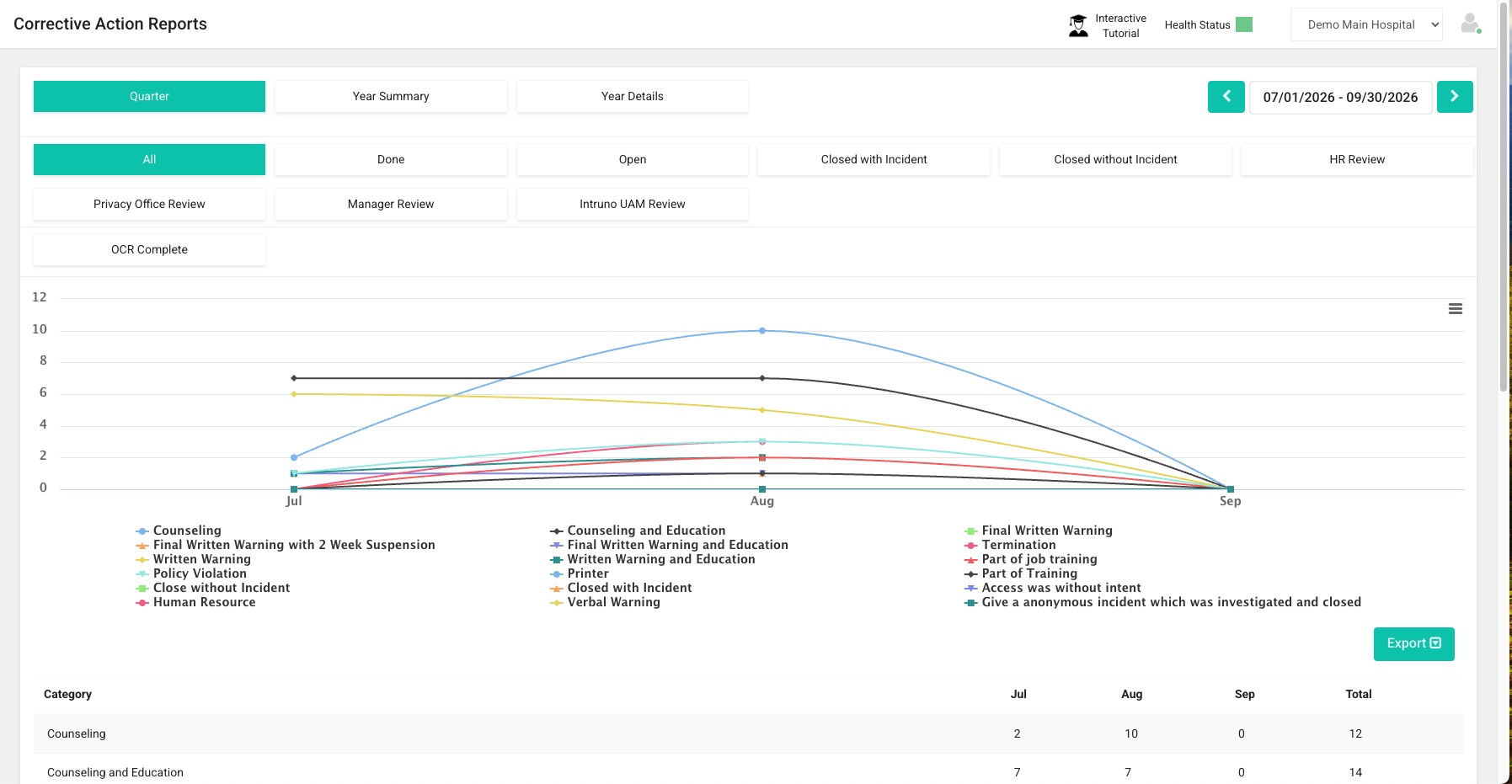
Track outcomes such as counseling, written warnings, and terminations by quarter or year, filtered by investigation status.
Reports built to fit the question
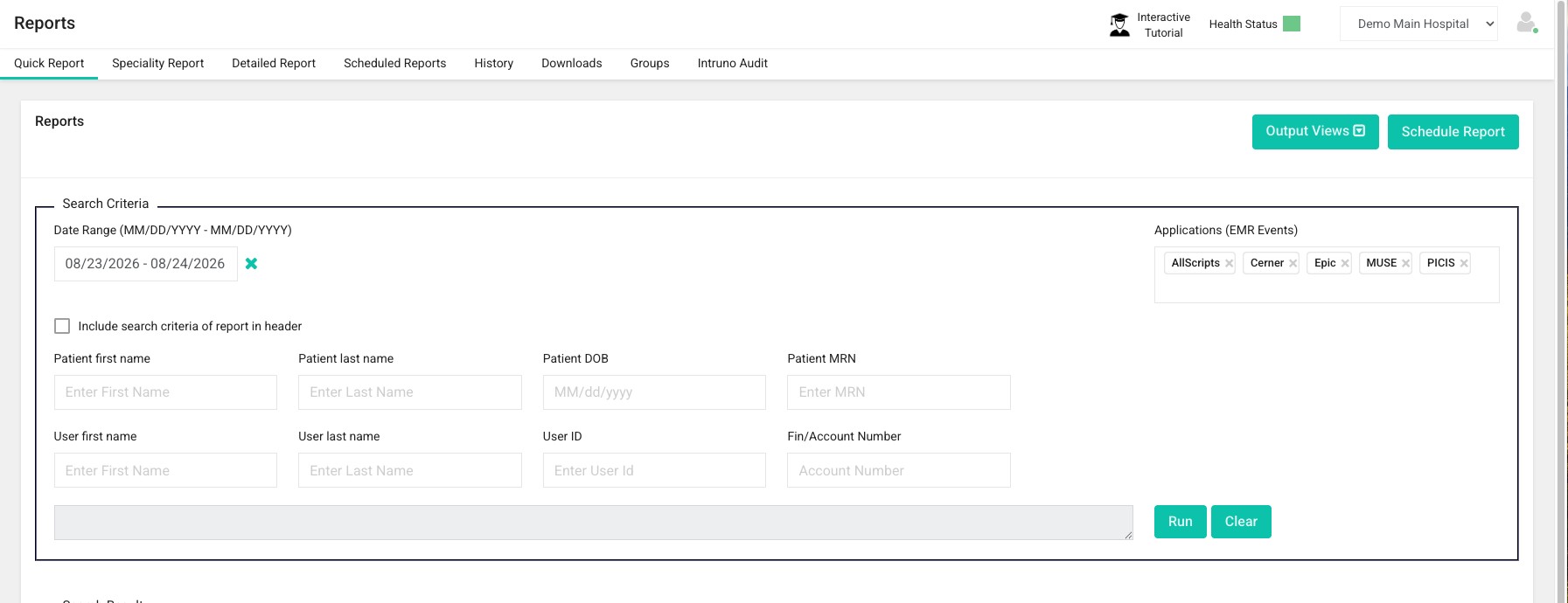
Run quick lookups by patient or user across connected EHR sources, use pre-built report types, or build a detailed custom report. Every report run is logged.
The same data answers a different question for every role in the organization
Operational intelligence is not one report sent to five audiences. It is different answers to different questions, all drawn from the same underlying program data.
| Audience | Question they need answered | Intelligence they receive | Decision it enables |
|---|---|---|---|
| Privacy Analyst | What needs my attention today? | Open case queue, findings awaiting review, overdue tasks, caseload by priority | Which case to work next; where to request support |
| Privacy Manager | How is the team performing and where is the bottleneck? | Team caseload distribution, closure velocity, pending escalations, overdue corrective actions | Where to reallocate capacity; which cases need supervisor attention |
| Chief Privacy Officer | Is the program improving and where is risk concentrating? | Program trends, department risk concentration, policy effectiveness, corrective action effectiveness, maturity trajectory | Where to invest training and policy resources next quarter |
| Executive Leadership | What is the organization’s privacy risk posture and is it getting better? | Risk trajectory, maturity indicators, compliance readiness posture, investment outcome evidence | Whether the program requires additional investment or leadership attention |
| Board | Can we demonstrate that privacy is being governed responsibly? | Program improvement trajectory, governance accountability evidence, regulatory readiness posture | Whether to accept management’s representation of program maturity |
| OCR / Regulators | Is there evidence of a consistent, improving privacy program? | Investigation record, corrective action documentation, policy review history, program improvement data | Whether the organization demonstrates a good-faith, improving compliance posture |
All views are generated from the same investigation, corrective action, and compliance activity data: no separate data source and no manual report preparation between audiences.
The best privacy programs don’t simply respond faster. They become smarter over time.
Maturity is a trajectory from reactive response to continuous, evidence-based improvement, earned through the accumulation of operational intelligence and the discipline to act on it.
Reactive
Investigations triggered by complaints or audits. Each case handled individually.
Analytics: None.Repeatable
Investigation process exists but is inconsistent. Documentation varies by analyst.
Analytics: Case counts only.Managed
Investigations follow a defined process. Evidence captured. Corrective actions assigned.
Analytics: Program-level visibility.Measured
Program data is visible across time. Trends and policy effectiveness begin informing leadership.
Analytics: Operational intelligence.Continuously Improving
Investigation data drives policy, training, and resource decisions. Audit readiness is a posture, not a project.
Analytics: Full intelligence suite.Conceptual illustration only, not a reference to an external maturity framework.
What operational intelligence changes at the most senior level
The outcomes that matter to the CPO, Chief Risk Officer, and board are strategic ones: better decisions, higher confidence, demonstrable improvement, and an organization that treats privacy as a leadership discipline.
Better decisions, earlier
When leadership can see where risk is concentrating, which corrective actions are working, and which violation types are trending upward, decisions about training, policy, escalation, and resources can be made earlier and with higher confidence.
The best privacy decisions are made before the problem is large enough to be obvious.Demonstrable program improvement
Longitudinal data on repeat violations, investigation velocity, and corrective action effectiveness provides evidence of improvement that survives regulatory scrutiny.
The answer to “is your program improving?” becomes: here is the data.Higher regulatory confidence
A structured, improving privacy program gives organizations a stronger position in regulatory interactions because the record demonstrates what was done and how the program responded.
Regulatory confidence comes from having the record that shows what you did and the data that shows it worked.Smarter resource allocation
Risk visibility by department, violation type, and trend direction makes training, supervisory oversight, and policy review investments defensible and directed.
Every resource allocation decision can be explained with data rather than justified with intuition.Credible board-level governance
Operational intelligence answers the board’s governance question with program trajectory, maturity indicators, and accountability evidence that leadership can evaluate.
Governance credibility comes from showing the board the program’s improvement trajectory.A program that improves itself
The highest expression of operational intelligence is a privacy program where investigations inform policy, corrective actions are chosen because evidence shows they work, and repeat violations become less likely.
The goal is not a program that handles violations well. It is a program that generates fewer of them.See how executive teams use intelligence to strengthen their programs continuously
A conversation focused on your program’s current state, where the data shows your highest risk concentration, and what the path to a measurably stronger program looks like for your organization.